
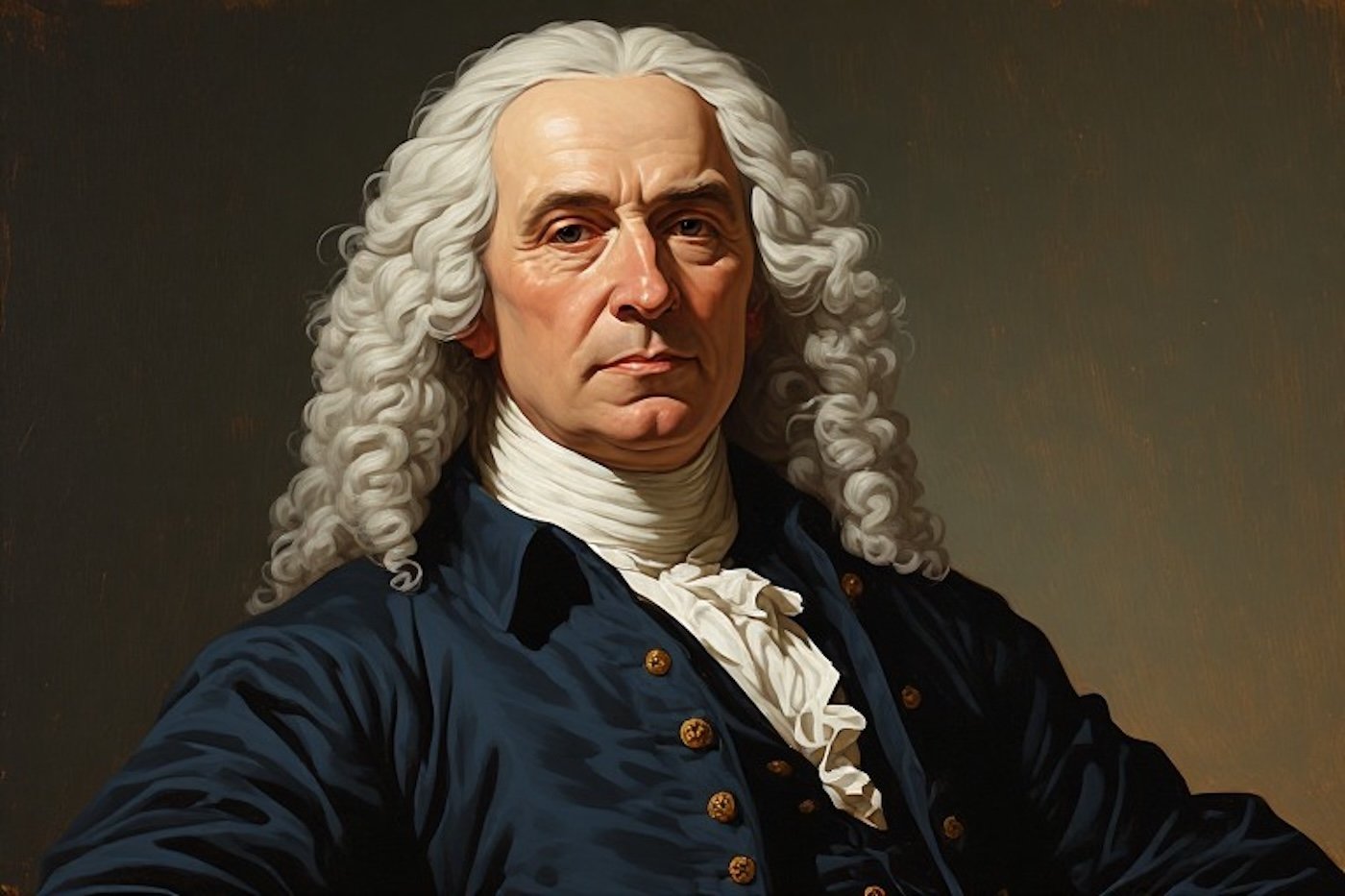
I have been reading a book by Pope John Paul II, and recently came across his discussion of René Descartes regarding one of the most famous sentences in Western philosophy:
Cogito, ergo sum.
“I think, therefore I am.”
I had encountered Descartes years ago in college, but this time something struck me that I had never considered before. The words sounded strangely familiar.
Thousands of years before Descartes, Moses stood before the burning bush and asked God His name. God answered:
“I AM WHO I AM.”
—Exodus 3:14
Was Descartes’s “I think, therefore I am” somehow a challenge to God’s “I AM”?
Two Very Different “I Am” Statements
Some quick research quickly informed me that Descartes was not an atheist trying to overthrow Christianity. He was a Catholic, and God actually played an important role in his philosophy.
Descartes was attempting to answer a different question: What can I know with absolute certainty?
What does that mean?
Suppose I doubt everything.
What if my senses deceive me? What if the world isn’t as it appears? What if everything I believe could somehow be mistaken?
Regardless of these doubts, there is one thing I can be certain of: The fact that I am doubting.
And if I am doubting, I am thinking. If I am thinking, there must be a thinker.
“I think, therefore I am.”
Descartes wasn’t claiming to possess God’s self-existent being. He was establishing what he believed to be the first certainty available to human knowledge.
However, in this process, something profound had occurred.
The classical Christian tradition begins with being—an objective reality created by God—and asks how the human mind comes to understand it.
Descartes shifted this paradigm. Rather than beginning with objective reality, he began with the thinking individual and asked what could be known with certainty from there.
The older Christian picture might be summarized:
God is → creation exists → I exist → I can know creation.
Descartes begins:
I think → therefore I know I exist → now I must establish what else exists.
That may seem like a small philosophical adjustment.
It wasn’t.
The Door Descartes Opened
Descartes himself did not throw God away. After establishing the certainty of his own existence, he argued for God’s existence and made God an important part of his explanation for why human reason could be trusted.
But later thinkers adopted Descartes’s starting point without retaining Descartes’s God.
The human mind increasingly became the center from which reality was examined. Reason, consciousness, and the autonomous individual assumed greater importance.
Descartes unwittingly opened a door, and many of those who followed him walked much farther through it than he did.
That made me think about another figure whose ideas also traveled much farther than their originator’s personal beliefs: Charles Darwin.
Darwin and Another Door
Darwin’s religious history is more complicated than I once understood.
He grew up within Christian culture, studied at Cambridge with the intention of becoming an Anglican clergyman, and was influenced by William Paley, who argued that the extraordinary design we observe in living creatures pointed toward a Creator.
But Darwin’s beliefs changed considerably over the course of his life. His doubts centered on suffering, questions about Christian revelation, and personal tragedy. By age seventy, he no longer described himself as an orthodox Christian. In an 1879 letter, Darwin wrote, “An Agnostic would be the more correct description of my state of mind.”
Nevertheless, Darwin’s theory of evolution by natural selection did something somewhat analogous to Descartes’s philosophical revolution. It provided a natural mechanism for explaining something previously attributed much more directly to divine action.
Natural selection described how populations change and how biological adaptations develop over immense periods of time.
But notice what Darwin’s theory does not establish.
It does not establish that God does not exist.
There is an enormous difference between these two statements:
Biological complexity can develop through natural processes.
and
Because biological complexity can develop through natural processes, there is no Creator.
The first is a scientific proposition.
The second is a philosophical conclusion.
And the second does not logically follow from the first.
When “How?” Replaces “Why?”
This distinction reaches far beyond Darwin.
Newton helped explain planetary motion through gravity.
Darwin helped explain biological adaptation through natural selection.
Neuroscience increasingly explains connections between our thoughts and activity in the brain.
Medicine explains illness through genetics, pathogens, immune responses, hormones, inflammation, and countless other biological mechanisms.
These discoveries are extraordinary achievements of human reason.
But none of them answers the ultimate question:
Why does any of this exist?
Consider a kettle of boiling water.
I can explain precisely why the water is boiling. Electricity passes through a heating element. Electrical energy becomes thermal energy. Heat transfers into the water until it reaches its boiling point.
That explanation may be completely correct.
But someone else can answer the same question by saying: “The water is boiling because I’m making tea.”
The molecular explanation does not disprove the person making the tea.
They are answering different kinds of questions.
Christianity understands creation in much the same way.
God is not merely another cause inside the universe competing against gravity, chemistry, genetics, or natural selection. If science discovers a natural mechanism, Christians don’t have to retreat and say, “Well, I suppose God wasn’t responsible for that after all.”
The natural mechanism can itself be part of creation.
Science can investigate how creation operates while philosophy and theology ask the deeper question of why there is a creation to operate in the first place.
Is the Universe Self-Explanatory?
This, I think, is where the discussion becomes much larger than either Descartes or Darwin. The real question isn’t whether we must choose between faith and reason. Nor must we choose between God and science.
The deeper question is:
Is created reality self-explanatory?
Suppose someday we understand vastly more than we understand today. Imagine that physicists explain the earliest moments of the universe. Biologists explain the origin and development of life. Neuroscientists explain every measurable process occurring inside the human brain.
We are still right to ask:
Why is there something rather than nothing?
Why do the laws of nature exist?
Why is the universe intelligible?
Why is the human mind capable of understanding it?
Why does anything possess existence at all?
Science will continue pushing the question of mechanism deeper and deeper.
But mechanism is not existence.
Explaining how something happens does not explain why there is something in which it can happen.
And suddenly we find ourselves standing with Moses again.
Back to the Burning Bush
Moses asks God His name.
God doesn’t answer by identifying Himself as one more being among all the other beings in the universe.
He says:
“I AM WHO I AM.”
Everything else we encounter has received its existence.
Stars exist.
Planets exist.
Animals exist.
I exist.
But none of these things contains within itself the ultimate explanation for why there is anything at all.
That is what makes the biblical declaration so extraordinary.
Descartes says:
I think, therefore I am.
Christianity can agree.
Yes, René. You are.
But then Christianity asks another question:
Why are you?
And that question takes us beyond Descartes.
Darwin can tell us something profound about how life changes.
Newton can tell us something profound about how objects move.
Neuroscience can tell us something profound about how the brain functions.
But Christianity insists that beneath every “how” remains the deepest “why.”
Paul expressed it beautifully when speaking in Athens:
“For in him we live and move and have our being.” — Acts 17:28
That may be the most important distinction of all.
Descartes discovered:
I am.
The biblical worldview goes one step deeper:
I am because He is.
And long before Descartes, Darwin, Newton, or any of us began asking questions about existence, the answer was already burning in the wilderness:
“I AM WHO I AM.”
Leave a Reply